 Skip to content
[Editor’s note: This review was originally published on May 15, 2026 during the 2026 Cannes Film Festival. A24 will release “Club Kid” in theaters on Friday, November 6.]
Ask any gay man with a social media account and they’ll probably have an opinion on Jordan Firstman. Seeking backlash, the queer actor and comedian has recently come under fire online for questioning the sexual reality of ‘passionate competition’ and has been labeled as outspoken or confrontational. He also has a history of working on sexually explicit projects, such as Sebastian Silva’s suicidal ketamine-based dark comedy “Rotting in the Sun.” His status as a self-aware, hyper-online provocateur might not seem to suggest the making of a bona fide filmmaker, but just wait.


As Firstman debuts his feature-length writing/directing debut, ‘Club Kid,’ that reputation may leave you wary, but this great film will put those nervous feelings to rest as it will carefully address a certain segment of the audience. Even his haters won’t be able to resist what’s presented here as a major filmmaking talent with a sensitive side that belies his brash internet-based persona.
He also stars as the lead in the first film, which is a huge crowd pleaser, extremely funny and poignant. Despite being unapologetically and unapologetically queer, this film plays on every side of the room. The film will likely lead Firstman-savvy viewers to immediately interpret “Club Kid” as an autobiography. That’s why.
He plays Peter, a party promoter now in his 30s after more than a decade of MDMA-fueled revelry. The kind where every day becomes a blur, marred by long, sweaty nights, and the horizon looms in the form of regret. Firstman may not be playing the game. himself But this time he is playing a game. version As he puts it, he’s spent enough time in Berlin that his new friends have labeled him “the Angel of Berghain,” but he’s now ready to leave the days of GHB, MDMA and other letters of the alphabet behind.
“Club Kid” is about what happens when the party lights come on, shame the next morning becomes a way of being, and the need to do it all again to avoid the aftereffects of last night. But it’s also about a serious warning! — Lost and Found Family Not only because of the queer community that formed around Peter, now an orphan living in rent-controlled Manhattan, and because his mother left him after her death, but also because he woke up one day to find the child he had fathered but never knew, literally on his doorstep.
“Club Kid” was shot on 35mm in New York City with a team of backers including “Anora” Oscar-winning producer Alex Coco and neo-filmmaker Olmo Schnabel, as well as a cast of millennial queer comedians. So it’s hard not to walk away from the movie thinking all it takes here is an A24 logo over the opening credits and you’re ready for the world to see it. But it doesn’t matter. Firstman’s aesthetic looms large on A24’s record, but this turns out to be an asset rather than a limitation.
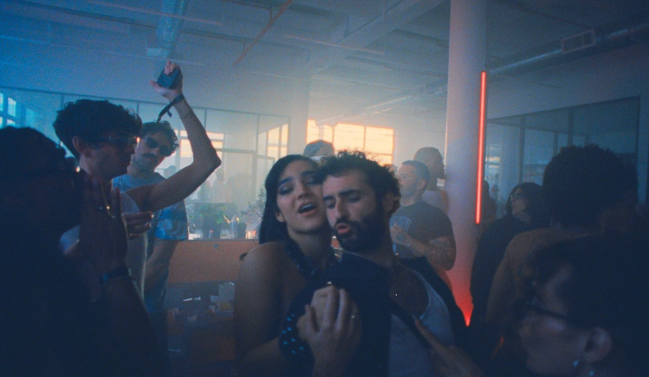
Beginning at a sensuously lit, drug-soaked party and ending with someone raging in the distance without you, “Club Kid” takes us back to Brooklyn 2016. Peter hops in an Uber with his friends, hops in a clown car, and screams Rihanna’s “Sex with Me” as they head to yet another bender to remember (but ultimately forget). Peter, an up-and-coming party promoter at the kind of club that now dominates Bushwick’s nightlife, ends up making a connection. connection — a few hyperactive “Hey, baby?” British women in the back room. Even though the movie smash ended “10 years or so later” and the proverbial car is still in decline, Peter is still living in it. Although it’s still more sweaty and tragic 10 years later.

He’s now made a career out of drug use, along with his best friend and business partner, Sophie (the wonderful, perpetually cocaine-smoking Cara Delevingne, who’s always two inches away from a breakdown). Just days before the man who set out to change his life showed up, they had an important meeting with FiDi investors to help them expand their New York party empire. But alas, unable to help himself once again the night before, Peter woke up drugged to the gills and rushed to the meeting, still nodding off at the table in a GHB-addicted stupor. (His reaction to a drop of hot sauce that looks strangely similar to the one he used to get drunk the night before is one of the movie’s great, funny little mistakes.)
All of this means that Peter’s life is still a complete mess, and his progress following a decade of partying has washed over him to the point where sobriety is now never a part of his day. (This is painfully true after a weekend spent debauched, hungover, watching Internet porn, and eating Popeyes in bed.)
But the party is definitely over 10 years ago when one of England’s “little ladies”, Edison (Kirby Howell-Baptiste), shows up with an eight-year-old boy at his apartment in London (the same one Peter shares with an “aspiring queer philosopher from Azerbaijan” who doesn’t pay rent). “You have a child! ‘hey!,’” she says, breaking the news to him that Arlo (played by supernaturally talented young actor Reggie Absalom) is in fact Peter’s child with one of the other women who just died during a heterosexual encounter in the opening scene. It was the first and only time Peter had sex with a woman, and now he’s ruined himself to the point where he has to finish raising the little boy.
The thought of not being able to send this child back to the UK sends signs of manic depression, more drug use and resignation.
It’s a little abrupt how quickly the transition goes from Peter feeling ill-prepared for parenting to a nurturing guardian, but it turns out he and Arlo have more in common than not. Arlo, for example, has the musical tastes of someone who grew up on Pitchfork and eagerly embraces the $300 Elliott Smith record that Peter later bought for him. (The film’s soundtrack, by the way, dominates everything from the film’s brooding final scenes by Arthur Russell to the deeply felt original score by “The White Lotus” composer Cristobal Tapia de Veer.) Their relationship quickly becomes the film’s unexpectedly sweet centerpiece, as Peter begins to truly understand and eventually love the traumatized Arlo.
Much of the success of “Club Kid” rests not only on Firstman’s shoulders, but also on the collaborators who work with him, including cinematographer Adam Newport-Berra, who captures the nightclub sequences filled with the grit and chaos of New York’s lost era. ‘Club Kid’ also utilizes the city in a way rarely seen on screen these days, using New York as a central character in the storytelling rather than just a setting.
“Club Kid” is freewheeling and relaxed, like the head rush of a fun party movie, until Arlo’s introduction. He appeared to feel more at home among the “family” of queer revelers that Peter discovered than in London, discovering his DJ skills in the process. Can Peter really be a father? The real emotional stakes begin to rise as they begin to recognize the unexpected realities of their new arrangement, such as getting Arlo into school or protecting the boy from his friends’ drug use while Peter’s drug use finally begins to decline. A tense, tentative romance with child psychologist Oscar (Diego Calva) comes into view, and Greg Araki’s name-checking of “Mysterious Skin” becomes more than just a tender confession, but a thrilling date begins.
‘Club Kid’ takes a sharp dramatic turn where Arlo’s living situation becomes much more miserable and possibly illegal, which would hardly work in a comedy like this. But it’s an unavoidable transition, considering that ‘Club Kid’ is structured like the rise and fall of a drug experience and the high point of falling into despair. The emotional arc bends toward “Kramer vs. Kramer” territory, with a cathartic (and well-acted by Firstman) courtroom scene. Peter may be insecure about his place in a world where only a select few have a place for him, but as an astute storyteller, First Man is anything but.
Firstman is now an established comedic voice, but here on all sides of the camera, his work has quite a bit of room left to be revealed, which could make him a real discovery beyond the Internet-bound gay audience. “Club Kid” has real potential to grow bigger than its apparent niche suggests. Firstman has finally eschewed the ironic poses he has taken online for years and emerged as a sincere storyteller with humor and heart.
Grade: A-
‘Club Kid’ premiered at the 2026 Cannes Film Festival. We are currently exploring US distribution.