 Skip to content
“Fjord,” Cristian Mungiu’s harrowing and provocative political drama, has now been out for two weeks. I have a question about this. Where is the argument? Where is the passion, the fire, the discussion, the debate, the noise, the sense that movies like this one matter? Everyone’s talking about “You Can See Everything,” analyzing the nuances and realities of deception, but should we blame it on Billy Evans? (You shouldn’t do that). And it’s a conversation well worth having. However, at the Cannes Film Festival last May <피요르드>When I saw it, I thought it was a movie that would spark 1,000 conversations, including some very inflammatory ones, because it gets to the spiritual and ideological core of a lot of what’s happening today.
instead… cricket. Oh, sometimes when I look at the comments posted on social media, I meet some passionate and intimidated people. blame But where is the spark of disagreement with the defenders of the “Fjord”?
I think the lack of discussion goes back to my Cannes experience, which I found both disturbing and revealing. “Fjord” was quite a hit there and won the Palme d’Or. That’s one of the reasons it’s being talked about as an Oscar contender, not only for International Film but potentially also for Best Picture. I am <피요르드>It was expected that it would set the media on fire as soon as it was released. But experiencing how people reacted to the film at Cannes, it seemed like almost everyone refused to say out loud what the film was actually about.
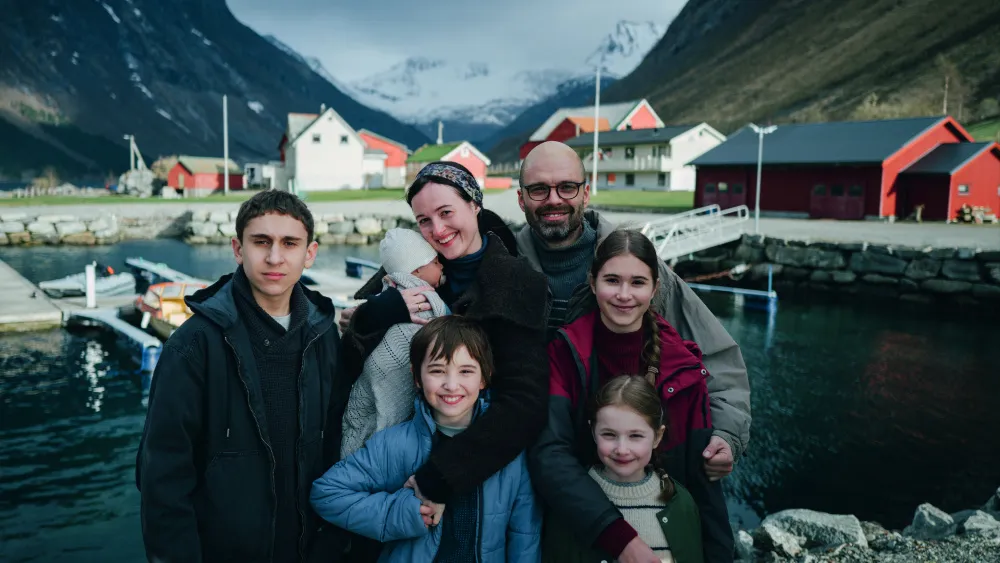
In “Fjord,” Mungiu tells the story of a Romanian family named Mihai Gheorghiu (Sebastian Stan). his Norwegian wife Lisbet (Renate Reinsve); Their five children then moved from Bucharest to the picturesque Norwegian coastal town where Lisbeth was born. The place feels like a quiet utopia, and for a while their life is good. But at school, the physical education teacher notices that the family’s teenage daughter, Elia (Vanessa Sevan), has a bruise on the back of her shoulder. It is clear that she has suffered some type of injury. A question arises: Was it the result of violence by one of the parents?
The movie doesn’t imply that it is. Georgius is depicted as a loving and rather gentle people in a somber evangelical Christian way. But when children are questioned, they admit that their parents sometimes hit them (in the form of a pat on the butt). Mihai admits to the police that he did this and that he sometimes hit the police’s hands (as a way to protect them). Keep your hands away from the stove). The case turns into an investigation into possible child abuse, and under the Norwegian system the children are immediately taken away and placed in foster care. For how long? Indefinitely. The Georges seem to have done nothing more than give their children a light slap on the back every now and then (something you wouldn’t dream of doing as a parent, although it’s not like one or two parents in the Western world haven’t done this). But when they head to court, the system seems almost designed to convict them. In essence, they face the possibility of their children being taken away from them through corporal punishment and even risk of imprisonment.
Me from Cannes <피요르드>We must have had 50 conversations about it. With two exceptions, everyone I spoke to had the same interpretation of the film. take side. I have heard this over and over again. But I just couldn’t believe it. Simply put, that interpretation doesn’t fit the movie I saw. Another thing that is hard to miss in Cannes is that many people <피요르드>The point is that there wasn’t much interest in it. But in the two weeks since the film came out, I’ve talked to many viewers who found it powerful. But most of the painful drama I experienced on screen was not reflected in the critical conversation about it. Here are some thoughts on the film and some incredibly impressive reactions to it.
Why do so many people claim that “Fjord” doesn’t choose sides? There are no saints in “The Fjord,” and the situations it describes are not without ambiguity. The Georgius family is a local Christian family who do not allow their children to use technological devices to connect with the outside world and supervise their children with strict, gentle and somewhat old-fashioned commands. As Elia develops a close bond with her renegade neighbor and classmate, Moora (Henrikke Lund-Olsen), her father expresses silent disapproval of what could be a romantic attraction. The film stares blankly at his homophobic conservatism. As ‘Fjord’ progresses, the film suggests that the hermetic nature of the way this family is raising their children is destined for trouble. In that sense, it is critical of family. But neither of these sins “balances” the drastic measures of the Norwegian government. To put it in melodramatic terms, the outline of the villain is clear in this film.
That villain is the nanny state. “Fjord” wears the cloak of a contemplative art film, but is essentially a political docudrama in the classic tradition of New Hollywood. The film is based on real-life cases in Norway mixed with elements from other European cases. Movies like “Norma Rae,” “Z” or “Erin Brockovich,” where the protagonist fights against an oppressive system. But in almost every case of this type of film from 55 years ago, the system in question is a right-wing government or a huge corporation allied with right-wing forces. In “The Fjord,” the force that threatens Georgiou’s family is Norway’s progressive bureaucracy: its children’s services agency. This institution has been programmed to err on the side of safety and, in this case, on the side of serious inhumanity.
No one wants to watch a sordid liberal political drama thinking that both sides are given equal weight. Well, “Fjord” isn’t like that either. But it’s hard to escape that feeling. reason Too many people have rationalized the film’s moral outlook as an example of ambivalence. This is because they do not want to admit that a film coming from within the progressive art-film world (Cristian Mingiu considers himself a liberal) can be critical of progressive consciousness.
“‘Fjord’ has been called a ‘MAGA movie’. Is that so? It is not in any way, shape or form. I respect “Fjord”, no MAGA and no trucks. At the same time, I am a staunch progressive who cherishes this film because I think it is essential for those of us with a progressive sense of justice to be able to look at our own position and see where it goes astray. “Fjord” explicitly criticizes a certain progressive mindset, one that is rigid, blind, and even authoritarian. The teachers and school officials who first call Georgius onto the carpet, and the Children’s Services officials who swoop in to investigate and prosecute them, are infuriatingly condescending and brazen. They’re talking about taking people’s children, which makes it sound like they’re discussing tax law. They know there is the weight of the system behind it, but what they also have is the weight of an ideology that places the unassailable issue of children’s welfare on a platform of absolutism.
The film is about something bigger than the ‘Norwegian system’.“Just as “Norma Rae” was about something bigger than the exploitation of cotton mill workers in North Carolina, “Fjord” is set with great precision in a specific time and place, but uses the specificity of that setting to comment on a more widespread ideological belief system and state of mind. right To take George’s children. Legally (in Norway) yes. But it reflects a belief in an omnipotent state authority. This is an ironic position for those who promise to protect the helpless. from forcible.
““Fjord” is a protest against anti-Christian prejudice. that The only message you got there was… The film deals with the spiritual war between New European progressives and Old European Christians. Norwegian officials were so suspicious of George’s evangelical roots and practices that their attitude could quite rightly be described as prejudiced. “Am I on trial for my beliefs?” Mihai asked from the witness stand. To some extent he is. But only to a certain extent. More importantly, if this is the only message to be taken from “The Fjord” – that the last thing a government that considers itself enlightened should do is oppress traditional Christian families because of their beliefs. If so, you’re missing the forest for the trees. Because that’s a theme you get in just about every liberal message movie. Don’t be prejudiced. But that is not the ultimate message of ‘Fjord’. The ultimate message of “Fjord” is: Beware of systems that are so confident of their own merits that they are willing to destroy what they pretend to save.