 Skip to content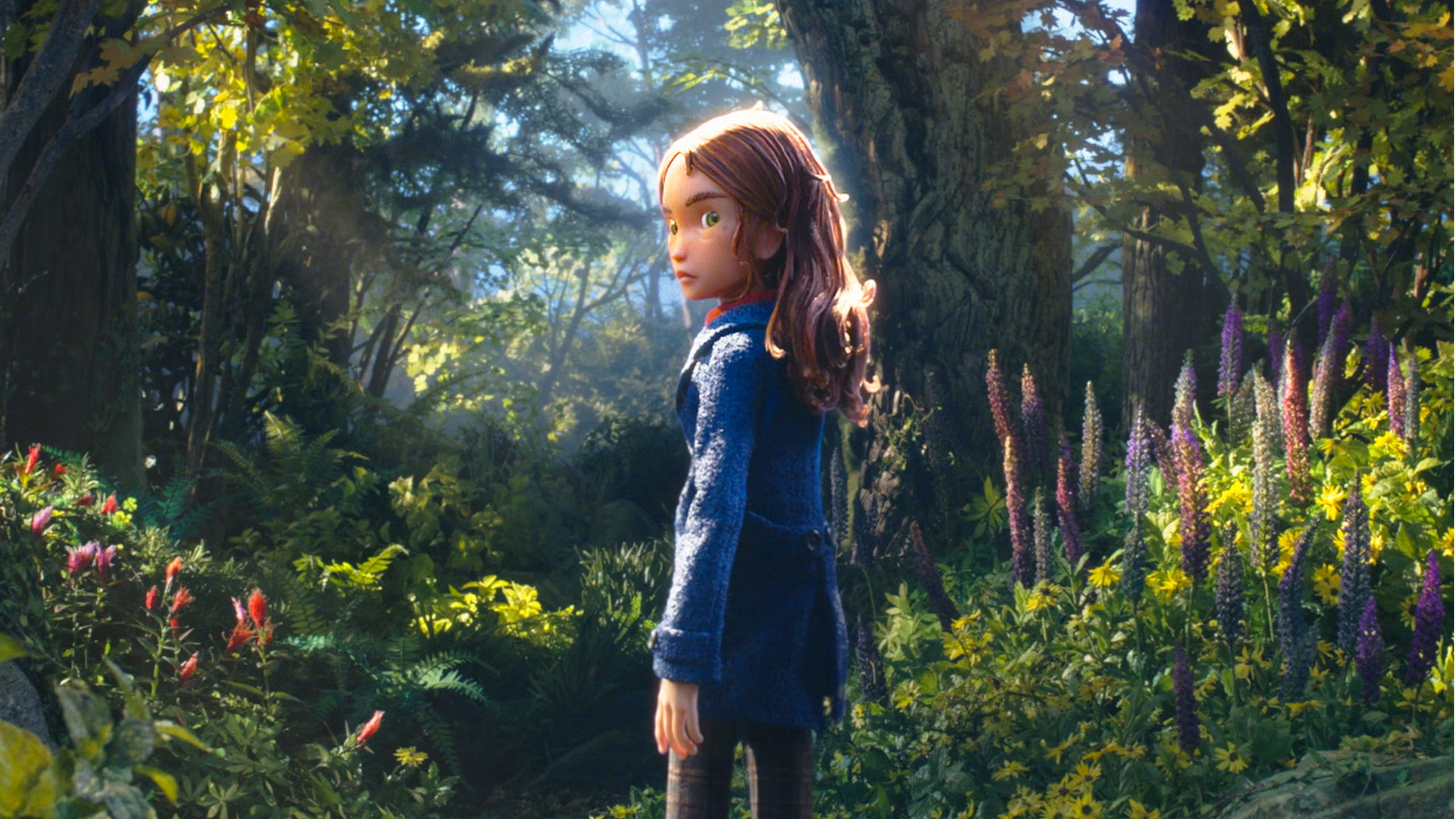
On the one hand, Travis Knight’s “Wildwood” is an epic, eye-popping, almost unfathomably well-produced celebration of everything that makes Laika special – everything that makes the Oregon-based stop-motion studio a unifying force for good in a film industry where most companies are more interested in seeing how many shortcuts they can take without breaking the magic of animation than in savoring it. On the other hand, the incredible amount of time and effort put into “Wildwood” doesn’t prevent it from being the least appealing of Laika’s films. Even if those flaws help strengthen the power of the story that magic can endure despite itself.

The longest and most ambitious film of its kind, this epic fantasy tale of the overlap between reality and imagination follows a Pacific Northwest teenage girl who ventures into a magical kingdom to rescue her baby brother, who has been kidnapped by Murder Crow. This film pushes the format to new extremes at a time when audiences are hoping to learn to settle for less. That’s a crazy feat of many things.
3D printed time 142,000 Various face models, 728 individual trees were hand-molded, and over 715 miles of brass wire were used over a 1,155-day production period. They created a “Braveheart”-style battle one frame at a time, brought the movie’s version of Portland to life by creating a perfect miniature replica of Powell’s City of Books (complete with a Drag Queen Story Hour sign), and even designed a tiny Decemberist poster to decorate the heroine’s living room. She seems to like their post-“The Crane Wife” stuff better, but I’m trying my best not to blame her for that.
Of course, that level of loving attention comes at a hefty price (with one minor exception, each of Laika’s films costs more and makes less money than the last), but studio owner and Nike co-founder Phil Knight can certainly afford the costs, and it doesn’t hurt to have his son running the store. Not all Hollywood Nepobabies are like that! Instead of fawning over the billionaire heir’s pursuit at length, let’s just say that if David Ellison could direct something as artistic and transcendent as “Kubo and the Two Strings” (or even something as competent and colorful as last summer’s live-action “Masters of the Universe”), the Skydance merger would probably seem a little less cataclysmic.
“Wildwood” demonstrates why Leica should be treated like a national treasure. It’s surprising, it’s truthful, and it’s a combination of American poignancy and a Ghibli-like willingness to push young audiences out of their comfort zone, seemingly at peace even as it loses enough money to sink any other animation studio on the planet. This is the ultimate proof of what makes Leica unique in many ways. It’s also the first film that doesn’t seem as special as many of the others seem (and sometimes don’t seem as special as they should feel).
Appropriately for a project that suggests Laika’s care alone may not be enough to preserve its magic, “Wildwood” is a story about losing faith in the wonders of the world. And appropriately for a project that, despite its flaws, still has so much to offer, “Wildwood” is also a story about how magic can persist in our lives even after we stop believing in it. Even after childlike innocence has been replaced by something spotty and imperfect.
The story comes from Knight and Laika staff screenwriter Chris Butler, adapted from the 2011 novel of the same name by Decemberists frontman Colin Meloy and the Carson Ellis illustrations that brought it to life. (Ellis is Meloy’s wife, and her album art is vital to the Decemberist identity, as are her early songs about castaways, disconnection, and homesick soldiers.) The pictures were extraordinary, but the text was, unsurprisingly playful, allegorical and desireful, and desire came in waves.
In this “Wildwood,” the visual effects are exponentially more expansive and nuanced. The writing is not like that. that is Still, it’s often charming. It’s dark. It’s very dark. even <코렐라인>class <파라노르맨>Even by the standards of the animation studio that created it. (Parents should be advised from the first scene that there is a PG-13 rating, even though I think the film will be overall fun for most older children.) And for the time being, this film is unmistakably – inimitably – Laika’s work. Because no other studio will love Portland this much.
But for teenage Prue McKill (Peyton Elizabeth Lee), it seems hippie paradise is anything but. She rolls her eyes at her father’s plant collection, his bedtime stories about the “impenetrable wilderness” on the other side of the St. John’s Bridge, and perhaps her beloved red beanie when he’s not looking. (Mr. McKeel’s voice is that of the sweetly suffering Jake Johnson.) Prue barely acknowledges the man who passes her local coffee shop on a unicycle while he plays the bagpipes beneath a Darth Vader mask. It’s time for her to put childish things aside. Things like her immature friendship with Curtis Melberg (Jacob Tremblay), an adorable, round-faced nerd who’s still obsessed with playing tabletop fantasy games where she pretends to be the hero.

When Prue takes her younger brother Mac into town against their parents’ wishes, it’s Curtis who she bumps into (literally), and it’s also Curtis who’s there when the computer-generated crow is killed. massacreWhen given a number, scoop up Mac and fly towards the forest on the other side of the Willamette River. Mr. McKeel always talked about that forest. “There are places in the world people can never go,” McKeel says before crossing a foggy railroad track, where he barely manages to ride his bike across a foggy railroad track where he encounters a fascistic talking coyote played by Tom Waits (voice). This coyote is the most loyal of the many animals that grieving widow governess Alexandra (Carey Mulligan) conscripts into her uncertain war against the kingdom.
Does she want to dominate the impassable forest, or does she want to destroy it? Her intentions are as difficult to parse as her plans to carry them out (which involve seizing control over the sentient and powerful Ivy). But more importantly, Alexandra’s madness allows her to become Jadis, Sarumon, and the evil queen from “Snow White.” Because her pain transformed the special love she felt for her late son into a more general obsession with cheating death, or at least keeping it under her control. Mulligan sells her heroine’s grief and madness in venomous language, but her character’s struggle to negotiate the five stages of grief is buried within a fantasy saga that has a similarly difficult time harnessing obsession.
“Wildwood” is a visual composition of astonishing scale that Leica has never attempted before, but the brilliance and density of its design can’t help but call attention to the ordinariness of its storytelling. Although the movie is too lovingly crafted to fall completely flat, it starts to feel dizzying after Curtis and Prue break up. (He must fight in the widow governess’s army, while she is imprisoned by the human bureaucrats she turns to for help.) That’s because the idiosyncratic genius injected into each frame rarely extends to the alchemy between them.
The individual sequences are incredible. Prue’s escape from the bureaucrat’s mansion chief, every new detail we learn about the impassable forest, and every new creature we encounter within it makes the world of the film not worth focusing on Laika’s hard work. I loved the flashy, theatrical owl Rex (“Celebrity Traitor” legend Richard E. Grant), but I felt betrayed that his only purpose was to establish Alexandra’s backstory. I was happy to hear that Mahershala Ali was playing the role of a bandit king named Brendan, but I was disappointed to see that his character was reduced to a mediocre archetype in his fight with Alexandra.

Elsewhere, “Wildwood” a little It makes more surprising use of celebrity voice actors Charlie Day and Awkwafina than most animated films that have come before, but it’s hard to shake the feeling that even Laika’s most ambitious project to date is hedging its bets by stealing a page from “The Super Mario Galaxy Movie” and “Angry Birds 2.” So while we’re presented in a film where the protagonist and studio struggle to bridge the gap between children’s sensibilities and adult concerns, there’s little beyond metatextual flourishes to help shape Prue’s journey of self-discovery. Prue’s boredom is diluted by the enchanted trees, the friendly rats, and the cavalcade of fearsome warriors she meets. All the 3D-printed faces in the world can’t keep these characters from feeling two-dimensional, and the film’s tireless efforts to fit Meloy’s novel into the 131-minute story force Knight and co. To make a compromise that ‘Wildwood’ can only survive if there is an abundance of wonder.
Despite ample screen time as a co-star, Curtis is the most obvious victim of these compromises. He makes sense as a counterweight to Prue’s precociousness, but he’s never given much of a reason for his own existence. A more adult film, or at least one that could explore the lifelong negotiation between holding on and letting go, might have foregrounded Prue’s mom (Maya Erskine) and dad after a mid-story revelation complicates their relationship with magical thinking. But even that bombshell plot twist proves a dud in a film that shares McKeels’ struggle to split the difference between imagination and reality. degree.
As tactile as it is, relying on the magic of illusion, Laika’s brand of stop-motion animation is the ideal medium for translating that struggle into art. Perhaps that’s why the studio’s newfound reliance on computer trickery through its collaboration with Wētā FX feels more like a symptom of Prue’s crisis than part of the solution. Of the film’s 2,804 scenes, 670 are CGI-enhanced, many of which are too obvious to ignore. This isn’t because the effects work is glaringly obvious (much of it is seamlessly woven into Laika’s signature look), but rather because it’s impossible. The film’s digital environments, cannon blasts, marching coyote armies, and soaring walls of wild ivy all stand in direct opposition to what human hands can do, and the film’s most impressive scenes are deflated in part by the grotesqueness of their creation.
Of course, only partially. Just as courage does not mean fearlessness, and growing up does not mean throwing away all vestiges of childhood wonder, so a trite story and a few digital embellishments do not mean that “Wildwood” is not a rare sight worth savoring, nor does it mean that Leica has somehow lost its way. In fact, the film seems to intentionally champion these flaws, as if the audience is focused on appreciating the beauty that survives those flaws. One particularly wrinkled figure says to Prue: “You don’t want to see any magic in the world, but you miss it in every blade of grass and every flower that blooms.” To watch a Laika film, or even especially this one, is to rediscover that magic everywhere you look.
Grade: B-
‘Wildwood’ premiered at the 2026 London Film Festival. Fathom Entertainment plans to release it on Wednesday, October 23rd. At the theater.