 Skip to content
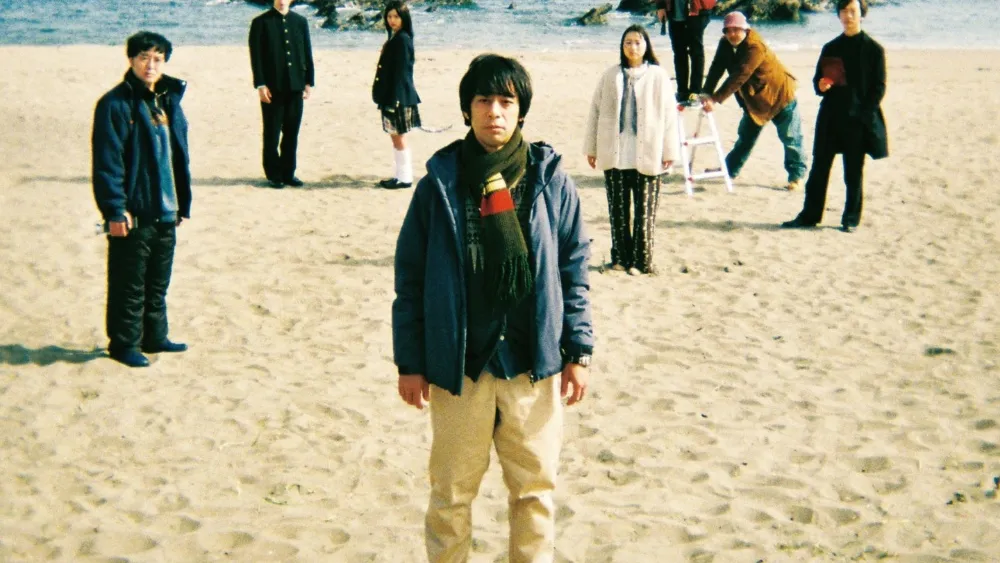
Director Shinichiro Ueda has earned a reputation for making films that embrace self-reflection. The beloved cult zombie film “One Cut of the Dead” was constantly shifting from single-take horror comedy to meditation on the act of filmmaking to actual on-set chaos.
His new film “Earthlings in Love,” which screened in the Nippon Cinema Now section of the 39th Tokyo International Film Festival, brings attention to how filmmaking affects us into a curious new space: vertically shot, social media-friendly microdramas.
‘Earthling in Love’ tells the story of director Shinpei, who discovers that he suffered from dementia when he was young. Going on a trip to record his memories, he decides to finish filming the movie he started making with his friends as a teenager. The film began with 30 short episodes released on social media, each just a few minutes long. According to Ueda, the enthusiastic online response encouraged a feature-length adaptation and theatrical release. manifold We spoke to Ueda about bridging the gap between mediums and making films about filmmaking.
Was the vertical filming method decided before writing the script or later?
I thought about the vertical format first and then the screenplay. The work itself was not initially conceived as a feature film. I planned it as an idea for a vertical social media, but I ended up doing it because I felt it had a personality that was better suited to a feature film.
[As for] Where the storytelling and concept came from, I visited a local village and met some old school friends there. As we drank and talked about our memories, we realized that even if we had experienced the same thing, there were differences in how we interpreted it and that some parts were completely forgotten. So my own experience serves as the basis for part of the story. I wanted to create a story about the difference between memory and what is written.
What appealed to you about shooting this way, and why did you have to readjust how you compose scenes with less horizontal space?
I think the screen ratio is really perfect for humans. [proportions] Very good. [While] Although it’s a great format for photographing a single person, it has some challenges and limitations when it comes to group shots.
Vertical framing often intentionally omits information that can later be discovered from other angles. Is this intentional?
This is how I utilized it. Everything is left to the viewer’s imagination. There’s another one, because the topic here is adolescent dementia. You may know that some symptoms of dementia limit your vision. So the vertical format with the viewing area omitted also actually has something to do with it.
You are also the editor of your film. How has the rhythm of editing changed between the Internet series and the full-length novel?
total [runtime] Out of a total of 30 episodes, it was 76 minutes long when it was originally released on social media. When I re-edited it into a feature film, it ended up being 111 minutes. On social media, you always have to be careful about keeping people interested. If you set it too slow, users will swipe to other content. But in the full-length version, you know that once you get to the theater and take your seat, you won’t leave. You have two hours to get their attention. So, I think I will be able to take advantage of that and invest time in directing, and under the assumption that I will focus on it for a while, I will be able to clearly show my acting skills.
As the runtime grew, did you reintroduce footage you had already shot or did you re-shoot it?
Both – there were some scenes and lines that couldn’t be included in the social media version, so we added them back into the feature. We also did some additional filming. And the social media version has a cliffhanger scene to encourage people to watch the next day, but we cut some of it out because it wasn’t necessary for the feature.
<원컷 오브 더 데드>me <스페셜 배우들> How did it compare to filming?
The only noticeable difference is the vertical framing, but to be honest, other than that I haven’t changed my approach from the feature film. If you think about Japanese actors, and perhaps even internationally, actors in short dramas or vertical formats tend to overact. The output is slightly larger. However, since the actors appearing in my work had experience acting in feature films, their acting was at the level of a feature film. So there wasn’t much difference other than the format.
You have previously presented a number of microdramas, what have you learned from them and presented ‘Earthlings in Love’?
when i think [about] What I learned and what the biggest difference is is not a matter of how I shoot or create the work itself. Above all, the viewers’ response is very fast. As soon as you launch something, you can see comments filling the space on social media platforms.
To give a very extreme example, there are cases where an idea comes to mind in the morning, filming during the day, and releasing in the evening. It’s like commenting or tweeting something. A feature film must begin with planning and take at least 12 months to be shown in theaters.
Having worked in both theatrical formats and microdramatic spaces, do you think theater spaces will continue to be valued?
I think both will exist in time. I think the vertical shorts market will grow further, but theaters will remain the same. Because now, at least in Japan, it’s the only place where people turn off their phones and sit together for two hours to listen or watch something. This is a quote from a senior director friend of mine. He said it was like a church or a shrine because you were sitting in the dark and everyone was together and listening. [someone] You’re preaching, right? It’s so unique and it’s like a ritual that will stick around because it’s the only place that works this way.